By:
Huaxinvending 2026-11-14Where Should You Put an Ice Cream Vending Machine in a Mall?
Choose a mall location for an ice cream vending machine. Compare three spots, plan the order and pickup area, and calculate the daily cups needed to break even.
Start with the edge of the food court, the waiting area outside a children’s play zone, and the cinema lobby. The best spot for an ice cream vending machine in a mall is usually the one where customers can see the offer before they pass it, stop without blocking a walking route, and collect a cup without crossing the order line. Shortlist a few spaces, then visit each one on a weekday and during a weekend rush.
A busy corridor can look promising on a floor plan. Stand where the customer would stand. Can a family with a stroller pull out of the walking flow? Can the next customer see the screen while another picks up a cup? The answers are often easier to see during a site visit than in the mall’s overall visitor count.
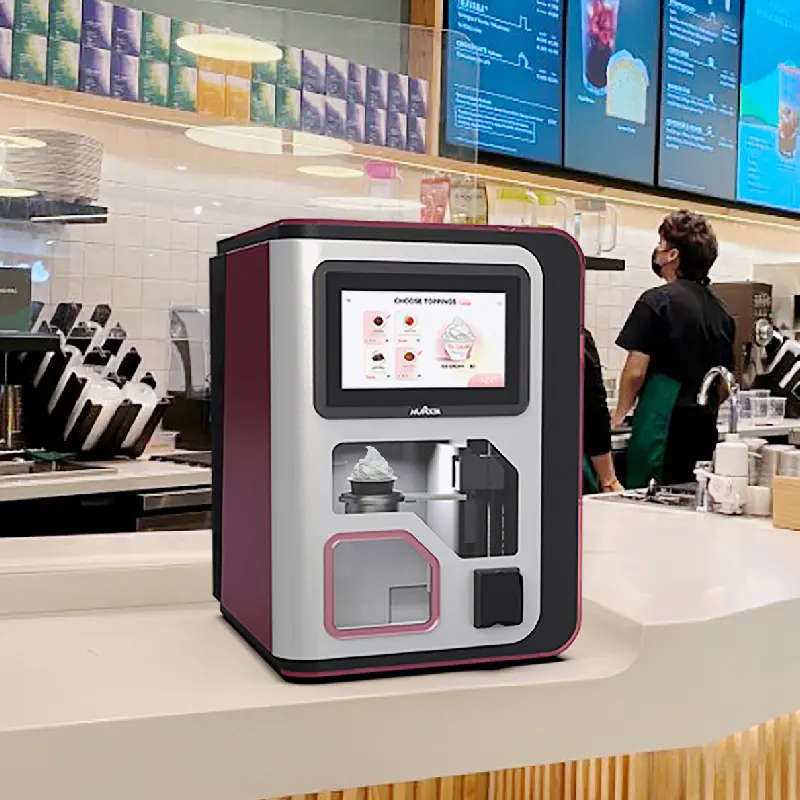
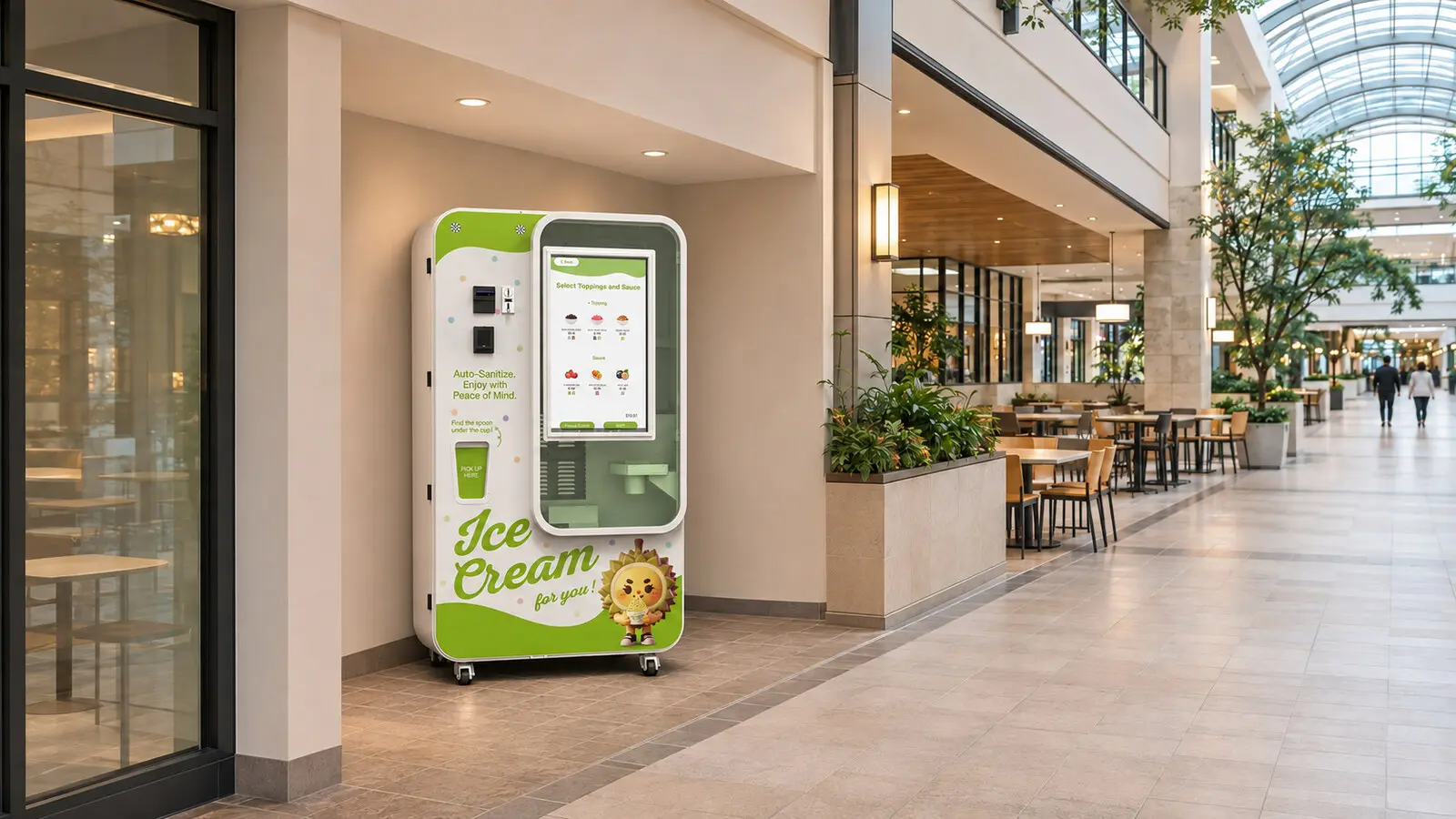
A Huaxin B83 Max in an illustrative mall alcove beside the food court.
Begin with the food court edge if you can see the machine from the route out of the seating area and there is a clear place to stop. Move the play area higher on your list if weekday visits also show families waiting near the proposed spot. A cinema location needs a closer look at the timing of arrivals and the length of the rush.
Also record how many parties pause in the proposed area and why they stop. Someone waiting for a table may have time to order. Someone stopping to let another person pass gives you a different signal. Before installation, pause counts can help you compare spaces. During a trial, record paid orders, cups per order, and failed or refunded transactions. Use those observations to estimate demand by time of day.
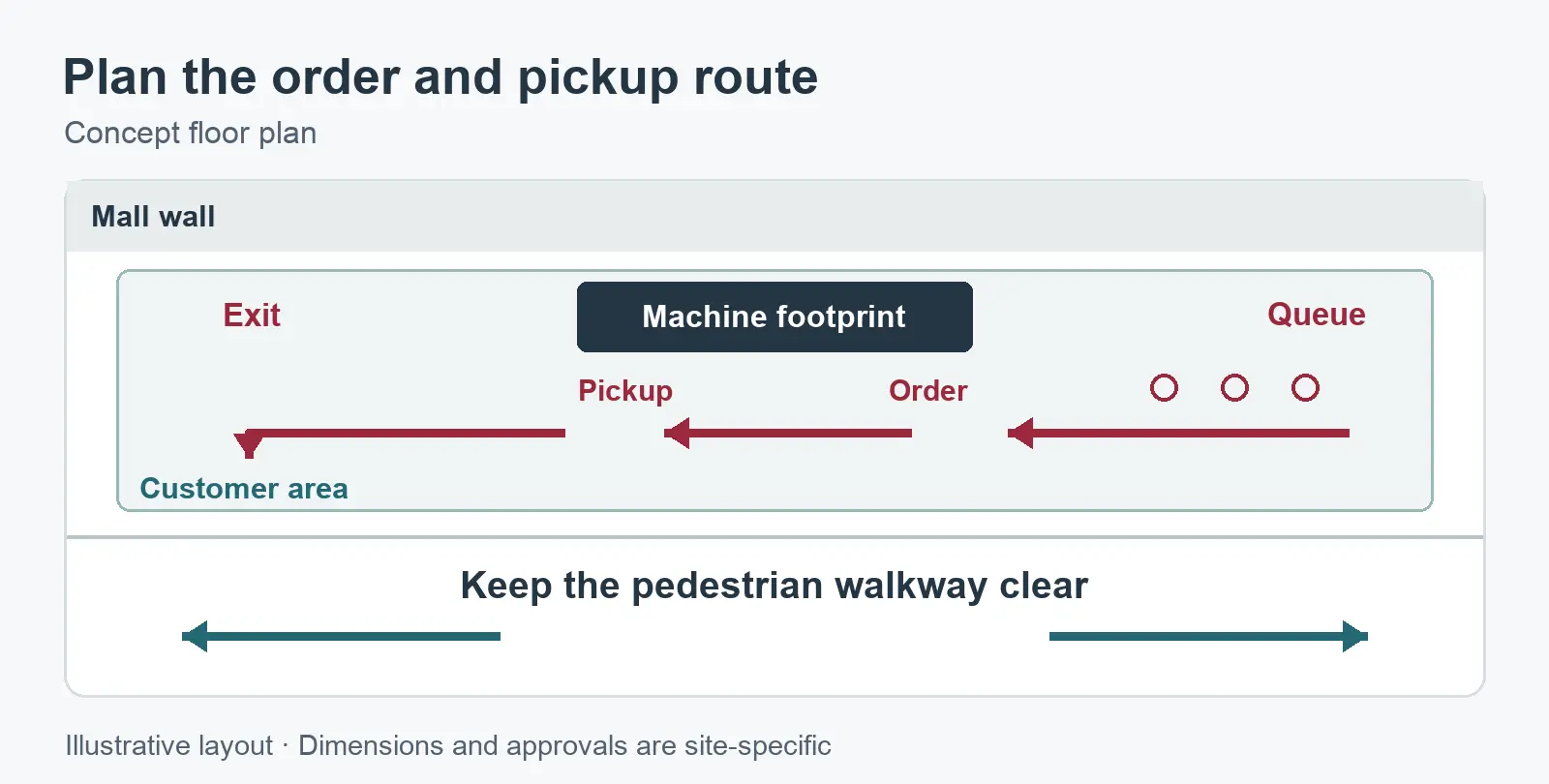
Concept layout. Confirm clearances, accessible circulation, and service access with the venue and equipment team.
Ask the mall’s specialty leasing or operations team to confirm the exact space in writing. Simon, for example, lists vending units among its short-term leasing options. Take a marked floor plan to the meeting. Confirm site-specific requirements for placement, opening hours, permitted food sales, and access for service.
On the same visit, check the route from the loading dock, the approved electrical connection, payment signal at the terminal position, and the room needed for ventilation and service doors. Agree where staff can bring in mix and cups and how they will remove waste. Use the installation requirements guide to record the measurements with the equipment team.
In a hypothetical trial with requests for 22 cups and 16 handed over within the window, six requested cups would still be outstanding at the cutoff. Check whether they were collected later, abandoned, or refunded. Watch for the cause. A congested pickup area calls for a layout change. Repeated slowdowns while payment and pickup are flowing warrant a capacity check. Run a second busy window to see how the machine handles demand after the initial burst. The cups-per-hour guide has a test record you can use.
Hypothetical Example — For Illustration Only. Assume 30 selling days per month, $5.00 net sales per cup, $1.40 in variable costs per cup, and $300 per month in other fixed operating costs. The share in this example applies to the stated $5.00 per cup. These figures illustrate the method in USD and cover ongoing site operations only.
Under these assumptions, both terms charge the same venue fee at 1,000 cups per month. Below that volume the percentage deal costs less in venue fees. Above it the fixed rent costs less. If the venue proposes a minimum guarantee or a percentage on sales above a threshold, model the exact clause. ICSC’s percentage-rent materials illustrate how the definition of reportable sales can change the amount due. Confirm how the agreement treats refunds, taxes, and discounts before using the percentage. Use the daily cups and break-even calculator to check a slow month and a shorter selling schedule.
Karen R. Pifer and Mark A. Arbus. Percentage Rent: An en “Gross”ing Dialogue. 2024 ICSC+U.S. LAW, 2024.
A busy corridor can look promising on a floor plan. Stand where the customer would stand. Can a family with a stroller pull out of the walking flow? Can the next customer see the screen while another picks up a cup? The answers are often easier to see during a site visit than in the mall’s overall visitor count.
A Huaxin B83 Max in an illustrative mall alcove beside the food court.
Compare Three Mall Locations
| Candidate spot | Why people may stop | What to verify on site |
| Food court edge | Diners may be looking for dessert as they leave the seating area. | Follow the exit flow. Check whether the machine would share space with another queue, and note which dessert options diners already pass. |
| Children’s play area entrance | Caregivers may have time to browse while waiting for children. | Check stroller parking, the check-in queue, and the play area’s food policy. Look for a place outside the gate where adults can order and collect a cup. |
| Cinema lobby | Arrivals and exits give you predictable periods to observe. | Watch the minutes before showtime and after a screening. Confirm the approved concession area and check whether customers can stop without entering an exit or ticket queue. |
Count the Traffic That Can Actually Stop
Mark a short observation line beside each candidate spot. For each 15-minute window, count parties walking past on the side that can approach the machine. Use the same counting rule at every location. Count a family walking together as one party and write down large groups separately if they could place multi-cup orders. Record the date, time, direction of travel, and any event that changes traffic, such as a movie ending or a children’s party arriving.Also record how many parties pause in the proposed area and why they stop. Someone waiting for a table may have time to order. Someone stopping to let another person pass gives you a different signal. Before installation, pause counts can help you compare spaces. During a trial, record paid orders, cups per order, and failed or refunded transactions. Use those observations to estimate demand by time of day.
Walk the Order and Pickup Route
Draw the cabinet footprint, ordering position, pickup area, and service access on a copy of the floor plan. Walk the route with two people. Have one person order and another collect a cup while a third position is reserved for someone waiting. If the pickup path repeatedly crosses the line, test a different orientation or another spot. Check how the layout works with strollers and mobility devices, and ask mall operations to approve the queue footprint and circulation around it.Concept layout. Confirm clearances, accessible circulation, and service access with the venue and equipment team.
Ask the mall’s specialty leasing or operations team to confirm the exact space in writing. Simon, for example, lists vending units among its short-term leasing options. Take a marked floor plan to the meeting. Confirm site-specific requirements for placement, opening hours, permitted food sales, and access for service.
On the same visit, check the route from the loading dock, the approved electrical connection, payment signal at the terminal position, and the room needed for ventilation and service doors. Agree where staff can bring in mix and cups and how they will remove waste. Use the installation requirements guide to record the measurements with the equipment team.
Test One Machine During a Weekend Rush
Use your busiest 15-minute window to set up a timed test. Ask the supplier or trial operator to reproduce the order pattern, including several people ordering close together and orders for multiple cups. Run the full sequence with the planned menu and payment setup. Record requested cups, completed cups, pickup wait, and orders still outstanding when the window ends.In a hypothetical trial with requests for 22 cups and 16 handed over within the window, six requested cups would still be outstanding at the cutoff. Check whether they were collected later, abandoned, or refunded. Watch for the cause. A congested pickup area calls for a layout change. Repeated slowdowns while payment and pickup are flowing warrant a capacity check. Run a second busy window to see how the machine handles demand after the initial burst. The cups-per-hour guide has a test record you can use.
Calculate How Many Cups the Location Must Sell
Compare the venue’s proposed rent or revenue share using the same operating days and the same contribution per cup. Calculate the contribution by subtracting ingredients, packaging, and variable payment fees from net sales per cup, then subtract any applicable venue share per cup. Include monthly operating expenses such as labor, connectivity, utilities, and maintenance in the fixed costs when they apply. Divide monthly fixed operating costs by the number of selling days and by the resulting contribution per cup. Round up the daily target and check that contribution remains positive.Hypothetical Example — For Illustration Only. Assume 30 selling days per month, $5.00 net sales per cup, $1.40 in variable costs per cup, and $300 per month in other fixed operating costs. The share in this example applies to the stated $5.00 per cup. These figures illustrate the method in USD and cover ongoing site operations only.
| Proposed venue terms | Monthly fixed costs | Contribution per cup | Operating break-even |
| $900 fixed rent, no sales share | $1,200 | $3.60 | 12 cups per selling day |
| 18% sales share, no fixed rent | $300 | $2.70 | 4 cups per selling day |
Choose a Spot for the Trial
Advance the space where the mall approves the layout, people can stop without blocking the corridor, and the team can refill and clean the machine during permitted hours. Put the weekday and weekend observations next to the break-even target. Agree on a trial period and what would trigger a move, such as a queue spilling into the walkway or several ordinary selling days below the operating target.Frequently Asked Questions
Is an escalator landing a good location?
Look at a nearby wall-side space after customers leave the landing. Verify that they can see the offer and move out of the pedestrian flow before stopping. Show the proposed queue on the floor plan for the mall’s review.What if the mall will only provide total visitor numbers?
Ask for counts by floor, entrance, or time of day, if available. Use short on-site counts at the actual machine position to measure how much of that traffic can see and approach the offer.Should I add a second machine if the first one gets a line?
Track wait time, completed cups, and failed or abandoned orders during several comparable rushes. Test pickup layout, payment, and stock availability first. Consider a second unit if the existing machine repeatedly falls short after those checks and the venue can approve the extra space.Discuss Your Mall Placement Plan
Share your country and city, a floor plan or photo, your preferred payment method, and your busiest observed 15-minute window. Ask Huaxin to review space, service access, and what to test before the site trial.References
Simon Property Group. Leasing Overview. Accessed November 2026.Karen R. Pifer and Mark A. Arbus. Percentage Rent: An en “Gross”ing Dialogue. 2024 ICSC+U.S. LAW, 2024.
PREVIOUS ARTRCE
How Many Cups per Hour Can an Ice Cream Vending Machine Serve?

About the Author: Huaxin Company Pioneer of Smart Ice Cream Vending Machines, with 13 years of R&D and manufacturing expertise. Holds CE, RoHS, NSF, and ETL international certifications. Holds over 24 patents in China and commands a 70% market share.